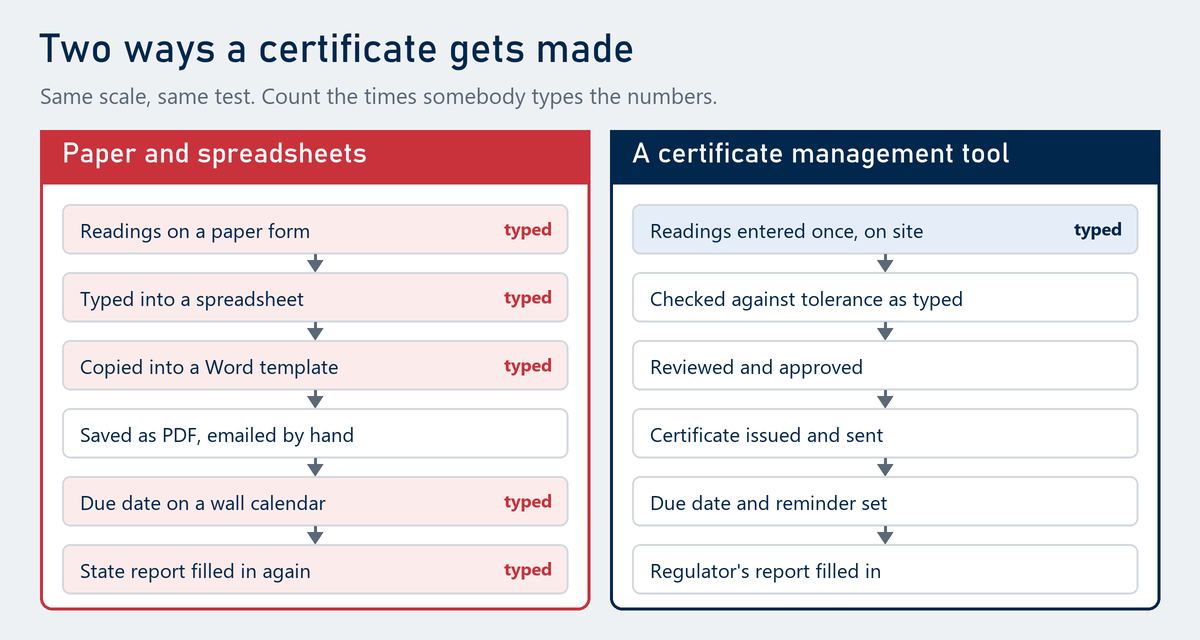
Ask anyone who's run a calibration business for a while how certificates get made, and you'll hear the same story. Readings on a form. Typed into a spreadsheet. Pasted into a template. Saved as a PDF and emailed. Due date on the calendar.
That worked when a certificate only had to say pass or fail. It doesn't anymore.
What changed
A certificate today has to stand up to an ISO assessor, an FDA auditor, a state inspector and the customer's own quality department, sometimes years after the work was done. In the last few years:
- ISO/IEC 17025 made uncertainty and a stated decision rule part of the certificate.
- USP <41> was revised for 2026: sensitivity, repeatability, minimum weight, and as found and as left testing.
- EURAMET cg-18 and cg-19 became what lab customers ask for by name.
- 21 CFR Part 11 means FDA-regulated customers need to know who signed, when, and that nothing changed since.
- Placed-in-service and USDA Packers & Stockyards reports repeat the same numbers on another form, with deadlines.
Every one of those is something a template can't check for you.
Where the time and the mistakes are
Every time a number is typed again, it can be typed wrong. A 9 becomes a 4. Last year's readings stay in the template. A certificate goes out citing a test weight whose own calibration ran out last month. None of that is carelessness. It's what happens when the same number passes through four people and four programs.
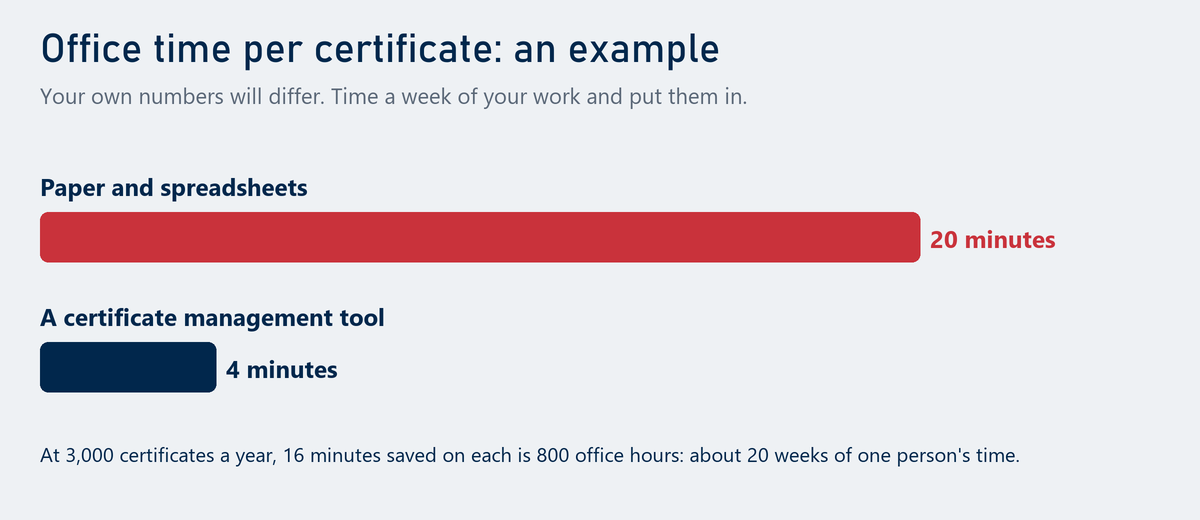
Then there's the time. In the white paper we walk through an example: a company issuing 3,000 certificates a year that saves 16 minutes of office time on each one gets back about 800 hours. That's 20 weeks of one person's time. Your numbers will be different, so time a week of your own.
What a good tool does
Plenty of programs can print a certificate. Fewer can stand behind one. The short list:
- Take the readings once, at the device, even with no signal.
- Check each reading against the right tolerance while the technician is still there.
- Know which weights were used, and refuse expired ones.
- Work out uncertainty and apply a decision rule.
- Send work to a reviewer, and keep a revision when something is corrected.
- Put a QR code on every certificate, and give customers their own portal.
- Fill in the state and federal reports from the same record.
- Keep an audit trail nobody can edit, and let you export everything.
The white paper has the full checklist, the reasons behind each item, and ten questions to ask any vendor before you buy, us included.
Read the white paper
Download Why Certificate Management Is a Necessity in Today's Calibration Business (PDF, free, no sign-up). Share it with your office manager, your quality manager, or whoever still has the spreadsheet open.