What they are
EURAMET is the association of Europe's national metrology institutes. Its calibration guides are the accepted way to calibrate common instruments and work out their uncertainty. Two matter most to scale companies:
- cg-18, Guidelines on the Calibration of Non-Automatic Weighing Instruments: scales and balances.
- cg-19, Guidelines on the Determination of Uncertainty in Gravimetric Volume Calibration: pipettes, burettes and volumetric glassware, calibrated by weighing the water they deliver.
They aren't European law. They're good practice that labs all over the world, and their auditors, expect.
Why it matters
- Handbook 44 says pass or fail. EURAMET says how sure you are. A lab needs the error at each load and the uncertainty of that error to use the balance properly.
- ISO/IEC 17025 assessors know these guides. Following them is the shortest route to a defensible uncertainty budget.
- It opens the lab market. Pharma, food testing and research labs ask for it by name.
Where it applies
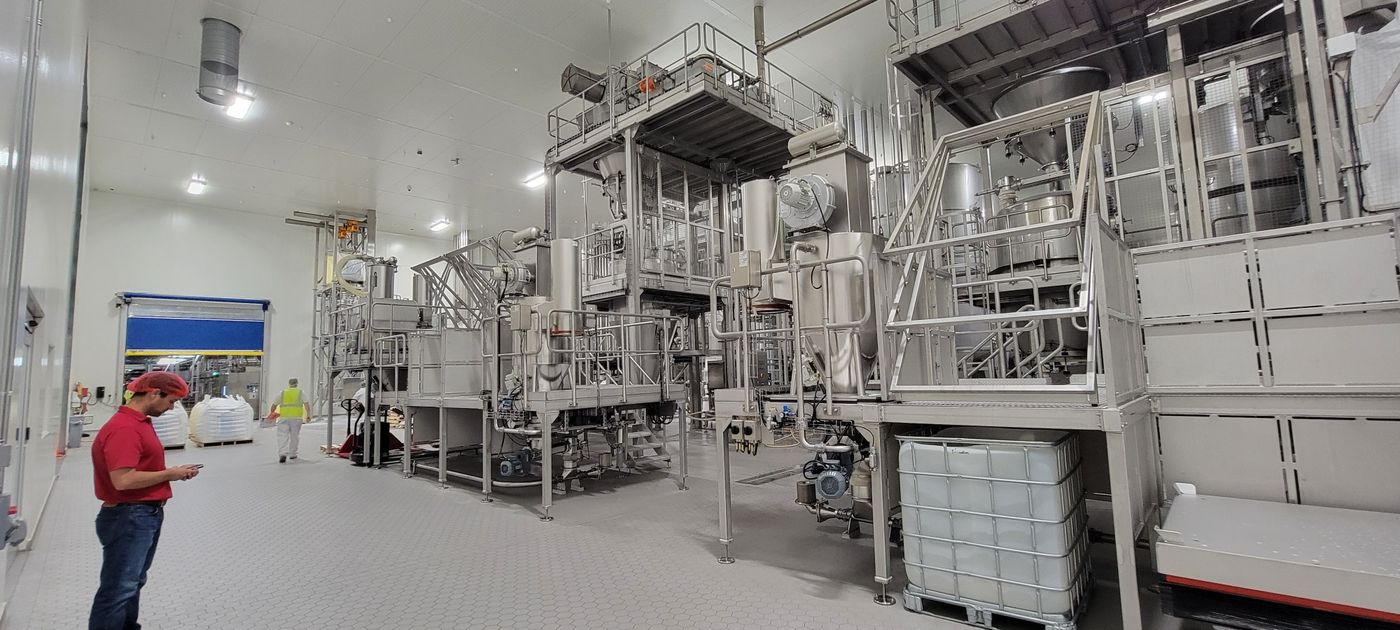
Laboratories and quality-controlled production sites: pharmaceutical, food, chemical, research and accredited calibration labs. A legal-for-trade scale is still tested to Handbook 44; cg-18 adds to that, it doesn't replace it.
How cg-18 works
- Repeatability: the same load, usually near capacity, several times (5 is a common minimum).
- Errors of indication: loads from small to capacity, usually at least 5 points.
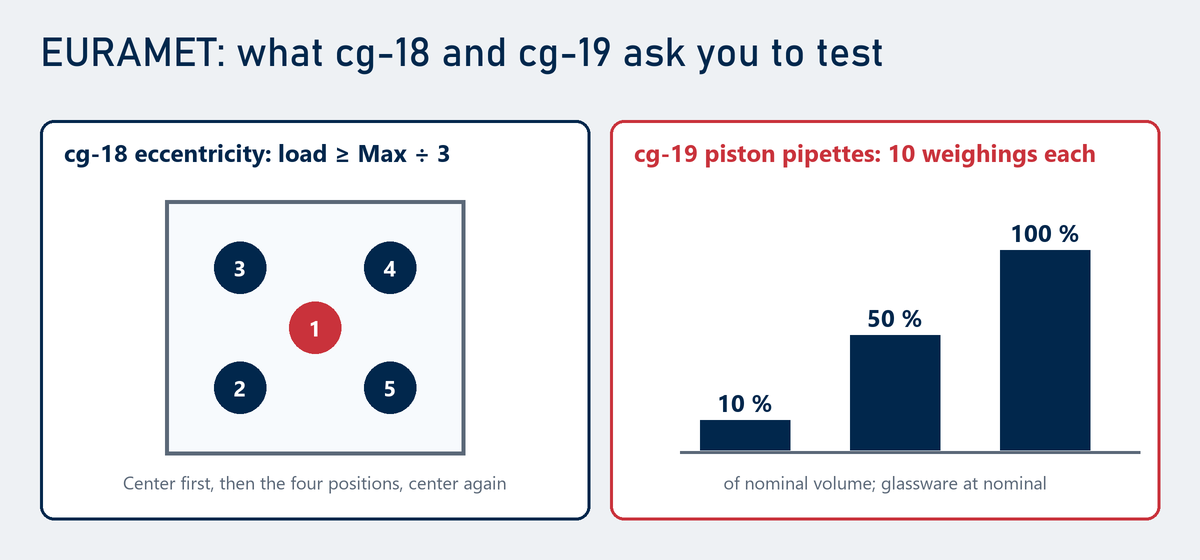
- Eccentricity: a load of at least a third of capacity at the center and four positions around it.
- Uncertainty: for each error, combine the rounding of the display, repeatability, eccentricity, the weights' uncertainty and drift, and air buoyancy, then expand it with a coverage factor (usually k = 2).
How cg-19 works
- Weigh the water the instrument delivers or contains, at least 10 times at each test volume (10%, 50% and 100% of nominal for a piston pipette).
- Record the conditions: water temperature for every weighing, and the air's temperature, pressure and humidity.
- Convert to volume at 20 °C, correcting for water and air density, the balance's weights and the instrument's expansion.
- Budget the uncertainty line by line: repeatability, the balance, evaporation, the water's temperature and density, air density, and the meniscus for glassware. The coverage factor comes from the effective degrees of freedom.
Who does what
- The customer asks for the guide and agrees which instruments it covers.
- The technician runs the full test set and records every reading and condition.
- The quality manager owns the uncertainty budget and validates it against the guide's examples.
- The reviewer checks the set is complete before the certificate goes out.
How CertaCal helps
Turn cg-18 or cg-19 on for a customer, a device or every device. The technician app adds the guide's tests and won't finish until they're done, the budget is worked out line by line, and the certificate says "per EURAMET" only when the guide was really followed.