What it is
USP General Chapter <41> Balances sets the requirements for balances used to weigh materials that a USP monograph says must be "accurately weighed". It's published by the United States Pharmacopeia. The revision in force from February 1, 2026 is the one to work to now.
The chapter asks for two tests: sensitivity and repeatability. Together they show the balance is accurate enough, and they set the smallest amount the lab can weigh on it.
Why it matters
- It's what the FDA and auditors check. A lab that weighs below its balance's minimum weight has a data integrity problem, and it will be found.
- The 2026 revision leans on the certificate. Calibration results need an uncertainty traceable to SI units and a decision rule, and testing is done as found and as left around significant work.
- It separates the service companies. Labs need a provider who knows the chapter. That can be you.
Where it applies
Pharmaceutical, compounding, nutraceutical and other regulated laboratories, on the balances they use for analytical weighing. The 2026 revision excludes balances used for manufacturing. The lab decides which balances are in scope.
How the tests work
Sensitivity
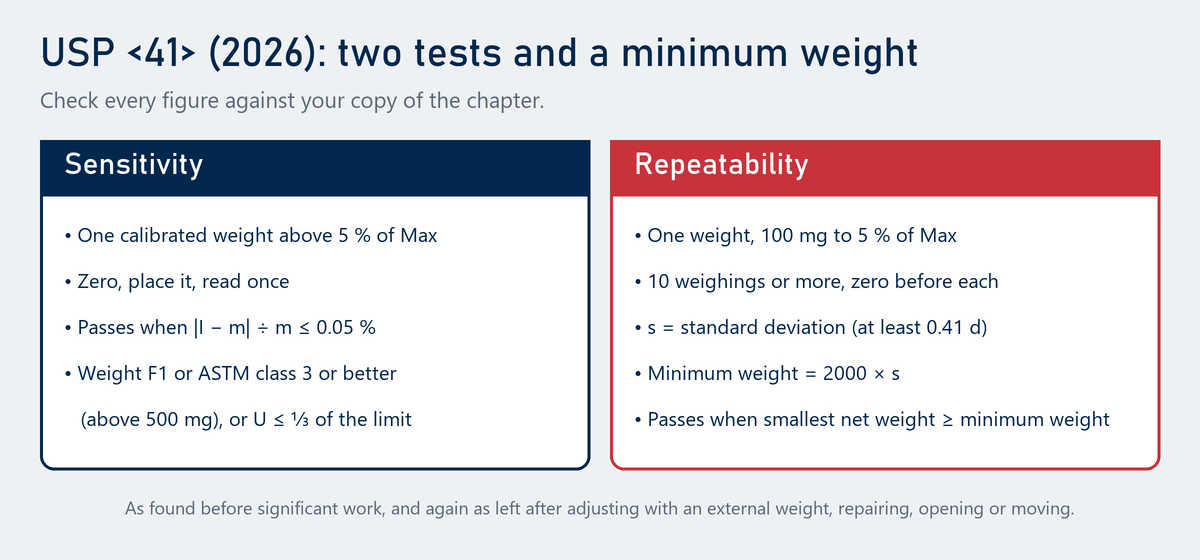
One calibrated weight above 5% of the balance's capacity, read once after zeroing. It passes when the reading is within 0.05% of the weight's value. The weight has to be good enough: OIML F1 or ASTM class 3 or better above 500 mg, or a certificate uncertainty no more than a third of the limit.
Repeatability
One weight between 100 mg and 5% of capacity, weighed at least 10 times at the center of the pan, zeroing before each. Work out the standard deviation, s. If s is below 0.41 of the scale interval, use 0.41d: readings rounded to d can't show a smaller spread.
The minimum weight is 2000 × s. Repeatability passes when the smallest net weight the lab actually weighs is at least that minimum weight.
As found and as left
Test before significant work. If you adjust with an external weight, repair, open or move the balance, test again afterwards. Levelling and the balance's internal adjustment don't count.
Ranges
On a multiple-range balance, test in each range the lab uses routinely.
Check every number here against your own copy of the chapter. USP text is official, and it's the copy you hold that an auditor will ask about.
Who does what
- The lab picks the balances in scope, sets each one's smallest net weight, and decides how often to check between calibrations. USP doesn't set a frequency; it's the lab's risk-based call.
- The service company runs the tests, reports the results with uncertainty, and states pass or fail by an agreed decision rule.
- The auditor checks that the minimum weight covers what the lab really weighs.
How CertaCal helps
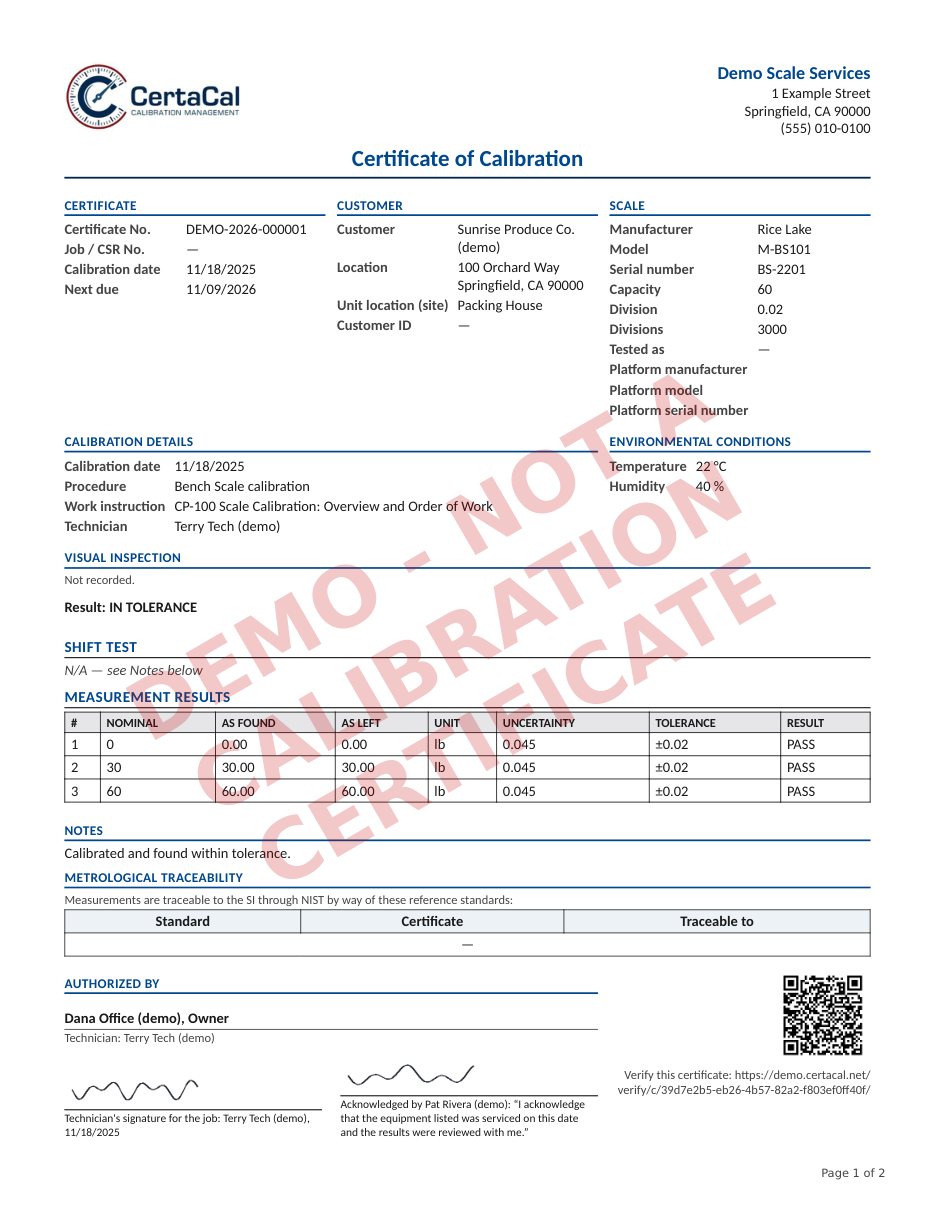
Switch USP <41> on for a customer or a single balance. The technician app adds the two tests, works out s, the minimum weight and pass or fail as the readings go in, won't let an unqualified weight be used, and asks for the as-left tests after significant work. The certificate reports it all and only states USP <41> compliance when both tests passed.