What it is
The Packers & Stockyards Act protects livestock and poultry producers from unfair trade practices, and accurate weighing is a big part of that. The scale rules are in 9 CFR Part 201. They require scales used for payment to be tested regularly and every test reported on a USDA form.
Why it matters
A producer is paid by the pound. A livestock scale that reads light by half a percent takes real money out of every load, and the producer has no way to see it. The Act puts the burden on the people who own and test the scale to prove it's right, twice a year, on paper.
For a service company, P&S work is steady, regulated and well paid, and it rewards the companies that are organized.
Where it applies
The rules cover scales used by stockyard owners, market agencies, dealers, packers, swine contractors and live poultry dealers. Each kind of scale has its own report form:
| Form | For |
|---|---|
| P&SP-4200 | Livestock and animal scales at stockyards, auction markets, dealers and packers |
| P&SP-4300 | Monorail (carcass rail) scales at packing plants |
| P&SP-4400 | Vehicle scales weighing live poultry |
| P&SP-4500 | Hopper scales weighing feed, where feed weight affects payment |
Reports go to the USDA regional office that covers the scale's state.
How the testing works
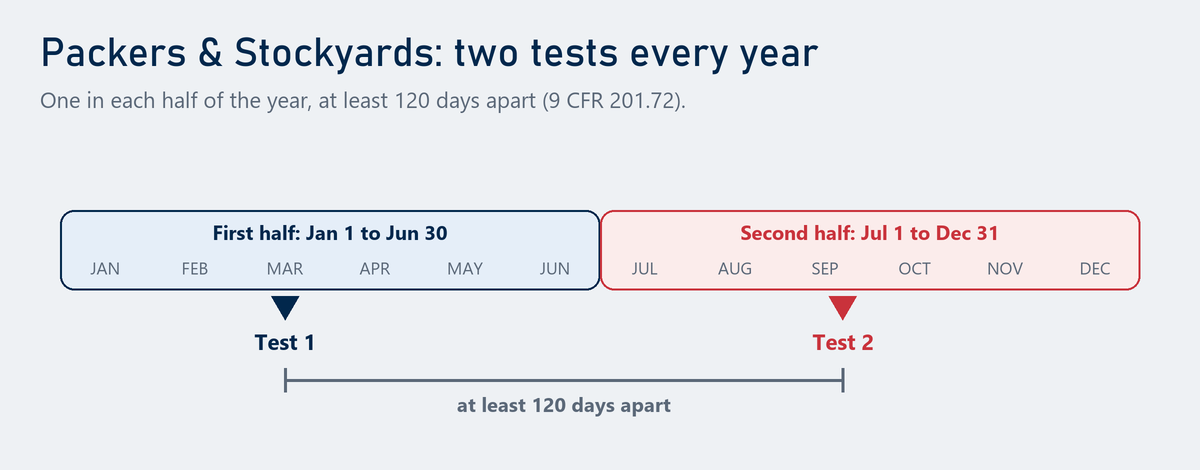
- Twice a year. Once between January 1 and June 30, once between July 1 and December 31, at least 120 days apart. A scale used only within one 8-month season can instead be used for 8 months after each test.
- Handbook 44 first. The scale is tested to Handbook 44 like any other legal-for-trade scale.
- Then the P&S limits. Motion detection and auto-zero have tighter limits; livestock scales must have the right number of divisions; and the scale is tested to its used capacity, worked out from the platform inside the rack and the heaviest livestock weighed.
- Test weights verified within 3 years. Bring the certificates.
- Fill in the form's own lines. Sensitivity or discrimination, the condition of the racks, deck and pit, the truck test on a poultry scale, and the result.
- Sign and send. The owner signs for the report, and it goes to the regional office.
Who does what
- The scale owner is responsible for getting the scale tested on time.
- The service company tests it as the test agency and completes the report.
- The USDA regional office receives the report and can reject it if something is missing.
- The producer is who all of this protects.
How CertaCal helps
Mark a scale as subject to the Act and pick its form. CertaCal shows when this half-year's test is due and the first day it counts, checks the P&S limits on top of Handbook 44, draws the report like the paper form, and emails it to the right regional office. The owner's copy goes with the certificates and into their portal.