
What it is
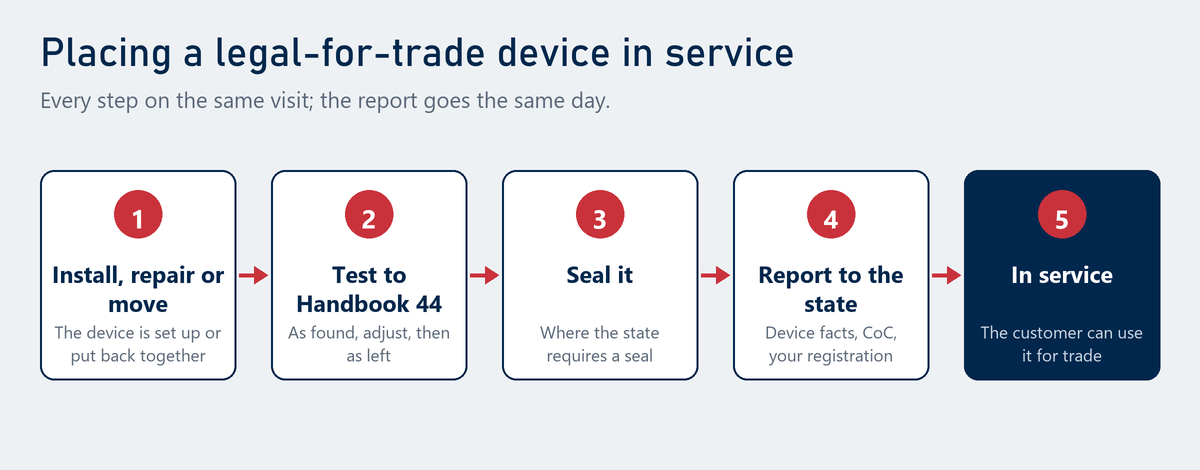
A placed-in-service report is the notice a registered service agency sends to the weights and measures authority when it installs, repairs, moves or removes a legal-for-trade device. It tells the inspector what the device is, where it is, who put it in service and that it was tested and found correct.
It's a short form: the owner and location, each device's maker, model, serial number, capacity and division, its NTEP Certificate of Conformance number, the seal or security, and your registration and license numbers. Short, but every line has to be right.
Why it matters
- It's the law. In states that require them, a device placed in service without a report isn't legally in service. Your customer can be told to stop using it.
- The inspector plans around it. Reports are how the state knows a device was put back in service after a repair, so it can schedule its own inspection.
- Your registration rides on it. Late, missing or sloppy reports are the easiest thing for a state to hold against a service agency.
- It protects you. The report is your record that the device left your hands correct, sealed and tested.
Where it applies
Rules and deadlines differ from state to state, and the deadlines are short. A few examples of where the report goes:
| State | Report goes to |
|---|---|
| California | The county sealer for the county the device is in |
| Arizona | The state weights and measures office (AZDA) |
| Illinois | The Department of Agriculture, Bureau of Weights and Measures |
| Pennsylvania | The Department of Agriculture's regional supervisor |
Other states have their own forms, or none at all. Check with each state you work in before you start, and again whenever a form changes.
How to do it well
- Register as a service agency in each state you work in, and keep every technician's license current.
- Collect the device facts on the first visit: maker, model, serial number, capacity, division, class and the CoC number off the NTEP certificate. Take a photo of the data plate.
- Test to Handbook 44 before you place the device in service, and seal it where the state requires.
- Send the report the same day you finish. Don't let them stack up for Friday.
- Keep a copy of what you sent, when, and to whom. If the office answers, keep that too.
Who does what
- The technician tests, seals and records the device facts on site.
- The office checks the report and sends it, and keeps the state's addresses current.
- The owner keeps the company's registration and the technicians' licenses in good standing.
- The customer can't use a new or repaired legal-for-trade device until it's properly placed in service.
How CertaCal helps
CertaCal builds the report from the technician's calibration, holds it until the registration, license and state office are set, and emails it to the right office when the job is finished. The customer gets a copy. Nobody retypes a serial number. See the Handbook 44 test it's built on.